| Vulnerabilities | |||||
|---|---|---|---|---|---|
| Version | Suggest | Low | Medium | High | Critical |
| 1.0.23 | 0 | 0 | 0 | 0 | 0 |
| 1.0.22 | 0 | 0 | 0 | 0 | 0 |
| 1.0.21 | 0 | 0 | 0 | 0 | 0 |
| 1.0.20 | 0 | 0 | 0 | 0 | 0 |
| 1.0.19 | 0 | 0 | 0 | 0 | 0 |
| 1.0.18 | 0 | 0 | 0 | 0 | 0 |
| 1.0.17 | 0 | 0 | 0 | 0 | 0 |
| 1.0.16 | 0 | 0 | 0 | 0 | 0 |
| 1.0.15 | 0 | 0 | 0 | 0 | 0 |
| 1.0.14 | 0 | 0 | 0 | 0 | 0 |
| 1.0.13 | 0 | 0 | 0 | 0 | 0 |
| 1.0.12 | 0 | 0 | 0 | 0 | 0 |
| 1.0.11 | 0 | 0 | 0 | 0 | 0 |
| 1.0.10 | 0 | 0 | 0 | 0 | 0 |
| 1.0.9 | 0 | 0 | 0 | 0 | 0 |
| 1.0.8 | 0 | 0 | 0 | 0 | 0 |
| 1.0.7 | 0 | 0 | 0 | 0 | 0 |
| 1.0.6 | 0 | 0 | 0 | 0 | 0 |
| 1.0.5 | 0 | 0 | 0 | 0 | 0 |
| 1.0.4 | 0 | 0 | 0 | 0 | 0 |
| 1.0.3 | 0 | 0 | 0 | 0 | 0 |
| 1.0.2 | 0 | 0 | 0 | 0 | 0 |
| 1.0.1 | 0 | 0 | 0 | 0 | 0 |
| 1.0.0 | 0 | 0 | 0 | 0 | 0 |
| 0.2.8 | 0 | 0 | 0 | 0 | 0 |
| 0.2.7 | 0 | 0 | 0 | 0 | 0 |
| 0.2.6 | 0 | 0 | 0 | 0 | 0 |
| 0.2.5 | 0 | 0 | 0 | 0 | 0 |
| 0.2.4 | 0 | 0 | 0 | 0 | 0 |
| 0.2.3 | 0 | 0 | 0 | 0 | 0 |
| 0.2.2 | 0 | 0 | 0 | 0 | 0 |
| 0.2.1 | 0 | 0 | 0 | 0 | 0 |
| 0.2.0 | 0 | 0 | 0 | 0 | 0 |
| 0.1.1 | 0 | 0 | 0 | 0 | 0 |
| 0.1.0 | 0 | 0 | 0 | 0 | 0 |
1.0.23 - This version is safe to use because it has no known security vulnerabilities at this time. Find out if your coding project uses this component and get notified of any reported security vulnerabilities with Meterian-X Open Source Security Platform
Maintain your licence declarations and avoid unwanted licences to protect your IP the way you intended.
Apache-2.0 - Apache License 2.0


Pure Rust implementation of Ryū, an algorithm to quickly convert floating point numbers to decimal strings.
The PLDI'18 paper Ryū: fast float-to-string conversion by Ulf Adams includes a complete correctness proof of the algorithm. The paper is available under the creative commons CC-BY-SA license.
This Rust implementation is a line-by-line port of Ulf Adams' implementation in C, https://github.com/ulfjack/ryu.
[dependencies]
ryu = "1.0"fn main() {
let mut buffer = ryu::Buffer::new();
let printed = buffer.format(1.234);
assert_eq!(printed, "1.234");
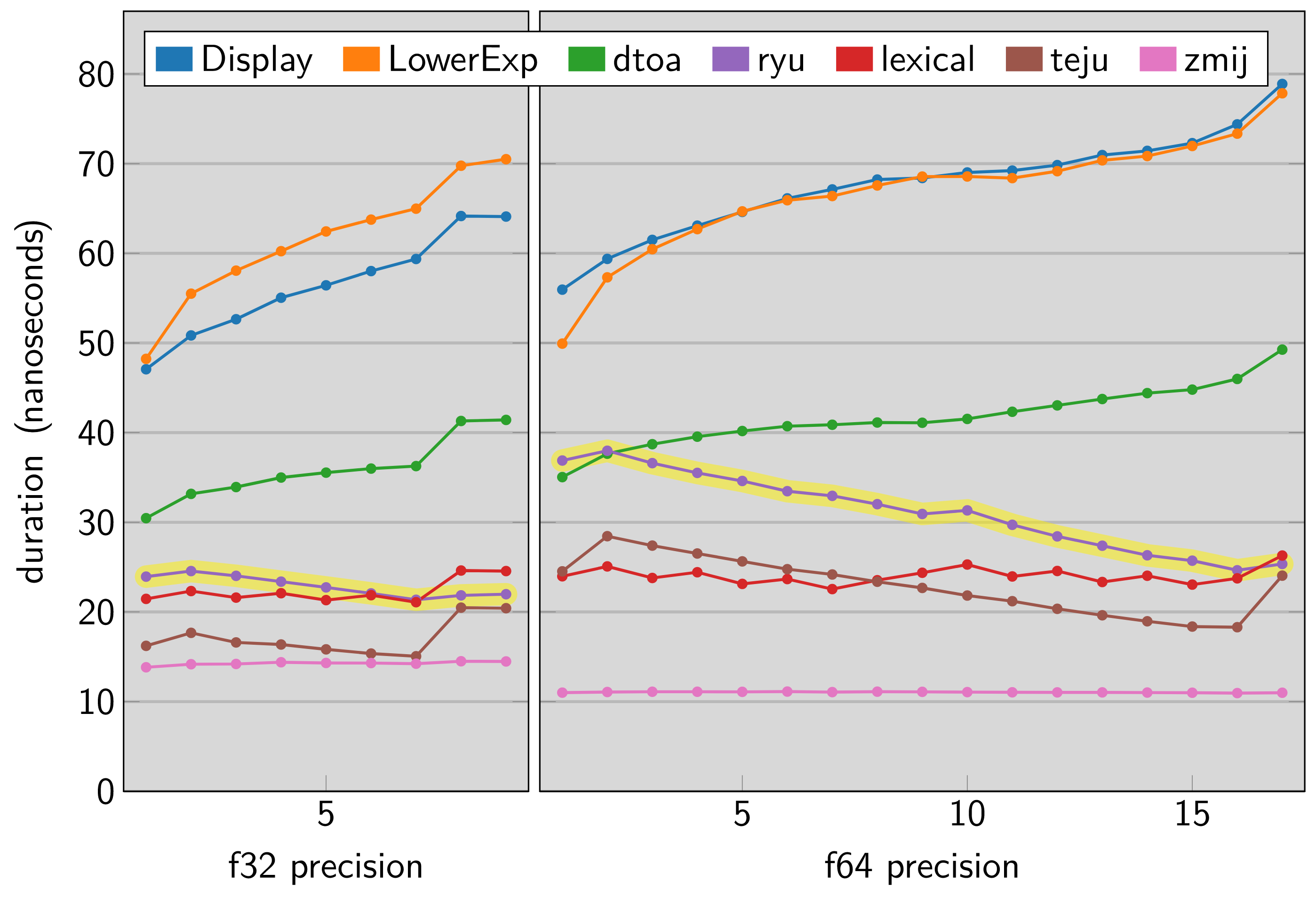
}The dtoa-benchmark compares this library and other Rust floating point
formatting implementations across a range of precisions. The vertical axis in
this chart shows nanoseconds taken by a single execution of
ryu::Buffer::new().format_finite(value) so a lower result indicates a faster
library.
You can run upstream's benchmarks with:
$ git clone https://github.com/ulfjack/ryu c-ryu
$ cd c-ryu
$ bazel run -c opt //ryu/benchmark:ryu_benchmark
And the same benchmark against our implementation with:
$ git clone https://github.com/dtolnay/ryu rust-ryu
$ cd rust-ryu
$ cargo run --example upstream_benchmark --release
These benchmarks measure the average time to print a 32-bit float and average time to print a 64-bit float, where the inputs are distributed as uniform random bit patterns 32 and 64 bits wide.
The upstream C code, the unsafe direct Rust port, and the safe pretty Rust API all perform the same, taking around 21 nanoseconds to format a 32-bit float and 31 nanoseconds to format a 64-bit float.
There is also a Rust-specific benchmark comparing this implementation to the standard library which you can run with:
$ cargo benchThe benchmark shows Ryū approximately 2-5x faster than the standard library across a range of f32 and f64 inputs. Measurements are in nanoseconds per iteration; smaller is better.
This library tends to produce more human-readable output than the standard library's to_string, which never uses scientific notation. Here are two examples:
Both libraries print short decimals such as 0.0000123 without scientific notation.